


The role that finds the money
Part 1 of the SuperTech Nomads Operating Framework · The Eight Roles
A scene you have seen before
A man in Mtwapa runs a small furniture workshop. Good work, honest prices, twelve years in business. On his phone are forty-one WhatsApp conversations with people who once asked “how much for a six-seater?” and never heard from him again after he sent the price.
He is not lazy. He is not bad at furniture. He is missing a role.
That role is R1.
Every business, from a duka in Kilifi to a software company in Westlands, has to answer one question before anything else matters: who is going to pay us, and how do we get them to say yes? In our framework that question belongs to one role, and only one. We call it R1 — Sales.
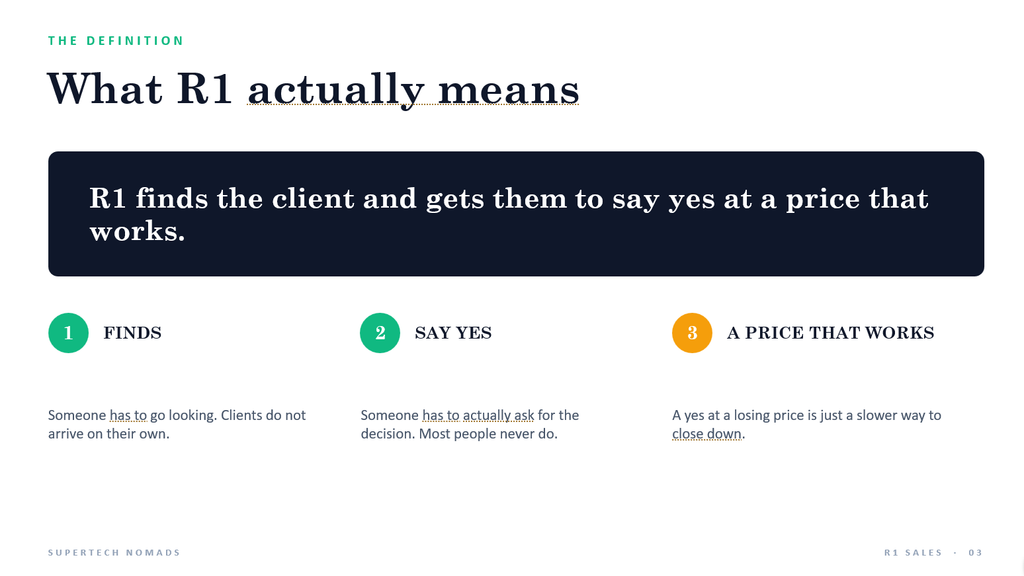
R1 finds the client and gets them to say yes at a price that works.
Read that sentence again, because three things are hiding in it. Finds — someone has to go looking. Say yes — someone has to ask for the decision. At a price that works — a yes at a losing price is not a win, it is a slower way to close down.
The misunderstanding that costs people their business
Ask most people in East Africa what “sales” means and they will describe a person who talks well. Someone who can convince you. The word carries a slight smell — the insurance agent who will not leave your office, the mali mali seller pushing socks through a matatu window.
So good, honest business people quietly decide that sales is not for them. They tell themselves the work will speak for itself. And then they wait.
Here is the correction, and it is the most important idea in this article:
Selling is not convincing. Selling is filtering.
R1’s real job is not to talk a reluctant person into paying. It is to move quickly through many people and find the few who already have the problem, already want it solved, and already have the money. Then help those people decide.
Convincing is exhausting and it produces bad clients. Filtering is calm and it produces good ones.
Once you see sales as filtering, everything changes. You stop feeling like a beggar. You start feeling like someone conducting interviews — because that is closer to the truth. You are interviewing them as much as they are interviewing you.
What R1 actually does, Monday to Friday
Five jobs. That is all.
One — Find. Generate people to talk to. Referrals, walk-ins, WhatsApp groups, church and chama networks, business associations, physically entering buildings. If nobody new enters the pipeline this week, R1 did not work this week, no matter how busy the week felt.
Two — Qualify. Decide fast who is real. Can they pay? Do they have the problem? Are we speaking to the person who decides? Most people cannot answer yes to all three, and finding that out on day one instead of day thirty is the whole skill.
Three — Propose. Put a number in front of them, in writing, with what is included and what is not. Verbal prices are how arguments are born.
Four — Follow up. Ask again. Then ask again. This single activity, done boringly and consistently, closes more business in East Africa than talent, price or design.
Five — Close. Ask for the decision plainly and take the deposit. Many people do everything else well and then never actually ask. The deal dies of politeness.
Notice what is not on this list. Building the thing is not R1’s job — that belongs to Engineering and Creative. Managing the project is not R1’s job — that belongs to Delivery Coordination. R1 hands over a signed client and a paid deposit, and then gets out of the way.
Ten things about selling here that the textbooks do not tell you
This is where most imported business advice falls apart. The sales books are written in California. Some of what they say travels. Much of it does not.
1. Trust moves through people, not adverts
In Nairobi, Kampala, Dar or Kigali, the strongest sales channel is a person vouching for you to another person. Church. The chama. The SACCO. Old schoolmates. The county business association. A WhatsApp group of hotel managers on the South Coast.
One warm introduction is worth roughly fifty cold messages. So R1’s most valuable weekly activity is often not selling at all — it is being present in networks where the buyers already are, and being known as competent long before anyone needs you.
Practical version: get invited into three WhatsApp groups where your buyers talk. Contribute genuinely useful answers for a month without pitching. Watch what happens.
2. The person in front of you often cannot say yes
This is enormous and outsiders miss it constantly.
The hotel in Watamu is owned by someone living in Nairobi, or in Germany. The church you are quoting has a committee. The family business is run by a son but the father still signs. The school has a board.
If you spend three weeks selling brilliantly to a manager who cannot approve spending, you have wasted three weeks. So R1 asks early, and politely: “When you are ready to go ahead, who else will be part of that decision?”
Not “are you the decision-maker” — that is insulting. The softer version gets you the same information and keeps the relationship warm.
3. Asking about money feels rude — ask anyway
There is a real cultural discomfort here about naming figures early. It feels grabby. So people dance around it, do free work, invest weeks, and only discover at the end that the client was thinking of a tenth of the price.
You must ask. But you can ask like this:
“So that I don’t waste your time with the wrong option — jobs like this usually land between eighty and two hundred thousand depending on how much we build. Does that sound like the range you had in mind?”
You have named a number without demanding they name theirs first. Their face and their reply tell you everything. This single question, asked in the first conversation, will save you more time than any other habit in this article.
4. Negotiation is not an insult, it is the culture
“Bei ya mwisho?” is not disrespect. It is normal. In many markets here, a price that is accepted immediately makes the buyer suspect they overpaid.
Two ways to handle it, and you must pick one deliberately:
- Build room in. Quote with a small margin you are willing to give away, so the client gets the satisfaction of a win.
- Hold firm with a reason. “This is the price because it includes X, Y and Z. I can reduce it to this figure if we remove X.”
What destroys you is the third way: dropping the price for no reason when they push. You have just taught them your first number was dishonest, and every future negotiation starts from suspicion.
5. “Willing to pay” and “able to pay” are different things
Enthusiasm is not money. Some of the most excited clients you will ever meet will never pay you.
The deposit is the test. Not a signature, not a promise, not a “tuko pamoja.” Money moving. Until the M-PESA confirmation arrives, the deal has not happened, and R1’s job is not finished.
This is why our framework puts a hard gate at Stage S4: no deposit, no work. R1 owns getting past that gate.
6. WhatsApp is your pipeline whether you planned it or not
Your clients will not fill in a contact form. They will send a voice note at 9pm. Business here happens on WhatsApp, and pretending otherwise is a way to lose deals to someone less skilled who simply replies faster.
Two disciplines make this survivable:
- Reply speed is a competitive weapon. In a market where most businesses take two days, replying within two hours makes you look like a serious company.
- Anything agreed on WhatsApp gets confirmed in writing. A voice note is not a contract. Summarise in a message: “Confirming what we agreed: scope is A and B, price is X, deposit is Y, we start Monday.” Ask them to reply “confirmed.”
One caution: if you are messaging people who did not ask to hear from you, understand that Kenya’s Data Protection Act treats that as direct marketing, and the regulator has issued real penalties for it. Get consent, honour opt-outs, and keep a record. Warm introductions do not have this problem — another reason to prefer them.
7. “Tuanze na kidogo” is usually a trap
“Let us start with something small first, then if it goes well we do the big project.”
Sometimes this is genuine. Often it is a way to get most of the value for a fraction of the money, and the big project never arrives.
R1’s job is to tell the difference. A real pilot has a defined scope, a real price and a written commitment about what happens next. A trap has none of those — just a vague promise about the future.
The safe answer: “Yes, we can start smaller. Here is the price for phase one, and here is what phase two would cost if you like the work.” Both phases priced, both in writing. If they will not agree to that, you have learned something valuable for free.
8. Silence is not a no — but you must be the one who breaks it
Pole pole is real. Decisions take longer here. Money arrives when a harvest sells, when a term’s fees are collected, when a season starts.
Most people send one quote, hear nothing, and quietly conclude the client is not interested. Meanwhile the client is genuinely busy and genuinely still interested.
Follow up on a schedule, not on a feeling: day 3, day 7, day 14, then monthly. Make each message useful rather than needy — a relevant example, a note about season timing, a small idea for their business. Most quotes die of silence, not rejection.
9. Learning to say no is a senior skill
Bad clients cost more than no clients. They pay late, expand the scope, call at midnight, and occupy the space a good client would have filled.
R1 must be allowed — expected — to decline work. “I don’t think we’re the right fit for this” is a complete sentence, and saying it early protects everything downstream.
If your business has no record of any turned-down work in the past six months, you are not qualifying. You are accepting.
10. In a small town, your reputation arrives before you do
On the Kenyan Coast, hotel managers know each other. In a market town, every serious business owner is two conversations from every other one.
This cuts both ways and it cuts hard. One badly handled job in Diani will be known in Watamu within a month. One excellent job will bring three enquiries you never chased.
So R1’s long game is not clever pitching. It is being the person who does what they said, at the price they said, on the day they said. In a small market that is the sales strategy.
How to tell whether R1 is working
You cannot manage what you do not count. R1 needs numbers, and they should be uncomfortable to look at.
| What to count | Every |
|---|---|
| New conversations started | Week |
| Proposals sent | Week |
| Signed contracts and value in KES | Month |
| Deposits actually received | Month |
| Conversion — proposals sent versus deals closed | Quarter |
| Where each closed deal originally came from | Quarter |
That last one matters more than people expect. After twenty clients you will discover that most of your business comes from one or two channels, and you were spending your energy on five. Then you stop doing three of them.
One number to watch above the rest: proposals sent per week. Not revenue — revenue is the result and it lags. Proposals sent is the cause, and it is fully within your control today.
What R1 must never do
- Never promise a delivery date. That belongs to Solutions and Delivery. A salesperson guessing at a timeline is how businesses acquire angry clients.
- Never change the price alone once a structure exists. Discounts have to be a decision, not a reflex under pressure.
- Never invent a feature to win the deal. “Yes, we can do that” said in a meeting becomes someone else’s impossible Tuesday.
- Never start work before the deposit. Ever. This one rule will save you more money than every other rule combined.
If you are a one-person business
Most people reading this are wearing all eight hats. That is normal and it is not a failure. But R1 is the hat that gets dropped first, because the other hats have deadlines and R1 does not.
Nobody is waiting for you to make a sales call. The client waiting on their website will chase you. The unfound client will not — they will simply hire someone else and you will never know they existed.
So protect it artificially:
Block two hours, twice a week, for R1 only. Not for building. Not for admin. Two hours to find people, follow up and ask for decisions. Put it in the calendar like a client meeting, because it is more important than most client meetings.
If you do nothing else from this entire article, do that.
The one habit
If you take a single thing away, take this:
Follow up one more time than feels comfortable.
Not louder. Not more desperate. Just once more than you would naturally.
That is where most of the money in East African small business is sitting right now — in quotes that were sent once, met with silence, and quietly abandoned by someone who assumed silence meant no.
Go and look at your WhatsApp. The furniture man in Mtwapa has forty-one of them. How many do you have?
Next in this series: R2 — Solutions. The role that turns “I want a website” into something you can actually price, build and be paid for.